The Deck Refit
After a great delivery north, it was now time to get stuck into the long-planned deck refit.
The Cambria hull refit had been in the planning since the 2014/2015 Hull refit but for a number of reasons it did not eventuate until the winter of 2023/2024. As mentioned in the start of the 2023 report, the shipyard of Robbe and Berking was chosen in Flensburg, Northern Germany. Wooden boats are part of life in Flensburg. Situated on the fjord, life revolves around boats of all persuasion out every day during the season.
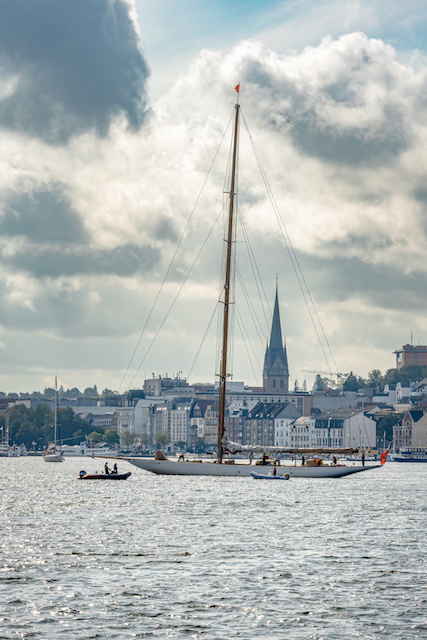
Arrival – photo by Joeran Bubke
There are always many reasons for deciding on where to intrust Cambria to such a project. It always revolves around people, and I’ve known Oliver Berking for many years. The works that come out of his yard I believe are actually more perfect than they were built originally. Olivers shipwrights and boat builders, led by Joe, Ingo, Chris and Kai are true artisans and masters of the skills, they also love what they do! Dave and I visited the yard in June of 23 to see the facilities. The shed is ideal, climate/humidity controlled with the engineering and cabinet making facilities in the same building. It was also 30 degrees C outside and glorious, the locals of course told us this was normal and to be expected on our return in September. Oliver also runs a young team of apprentices at different stages of their journey, all bright eyed and desperate for information and skills. The yard was always busy out of ours with individual projects moving ahead. The yard also allowed us to employ some of our old crew to help in keeping costs down and to push on through the weekends. This is an important part of choosing a yard as the crew past and present love the work of maintaining Cambria; they are all proud of the work and being part of the history. The yards in the UK were ruled out due to restrictions on importing Cambria’s teak supply. This had been accumulated over time since the 2014/15 refit and stored in Holland. The perceived downside was the location. I saw this as more of a positive. A beautiful part of the world at the end of a challenging voyage. The opportunity to take Cambria to parts of the world with passion for wooden boats and the art of boat building. A voyage throwing the challenges of the sea on a flat-water racing yacht and having a crew up for the job. Cambria’s mast is too tall for the Kiel Canal, so the only option was extra 1000nm’s over the top.
The scope of the work was to remove the current teak deck (1995), and sub plywood deck. To then investigate the pine deck below, laid in the Canary Islands circa 1978. Previous repairs and investigations on the coverboards had uncovered extensive rot in the pine and rust in the steel cover plates below. There were also tell-tale signs of rust stain in the deck head in the fore peak and lazarette, particularly at the helm seat. With this we knew the margins and fore/aft extremities of the deck were likely to need repairs. To do the work properly the mahogany deck “chock” and bulwark veneer would have to be removed, this allows access to the steel angle which runs the length of the deck cover board. This angle joins the cover plate, sheer plate and beam shelf together providing integral structural support and rigidity. We had already sourced all the lumber for the project; teak for external deck, Alaskan yellow cedar for repairs to the pine deck and Honduras mahogany JLVB had found in Finland. Other preplanned works included: service port and Starboard thrust bearing and Cardan shafts, draw both shafts, replace cutlass bearings, strip and oil mast/boom, check re-bed mast track and mast head fitting, removal/re-bed bowsprit heal fitting and repairs to bowsprit, replace original 2001 standing rigging, renew and update all electronic nav gear (including radar as we could no longer source spares for our Navnet system) and, of course, a fresh coat of paint for topsides and below water-line. There would of course be many other issues that would arise in such a project but to remain focussed on the primary goal would keep the finish line in sight and costs prioritised. The finish line being next seasons cruising.
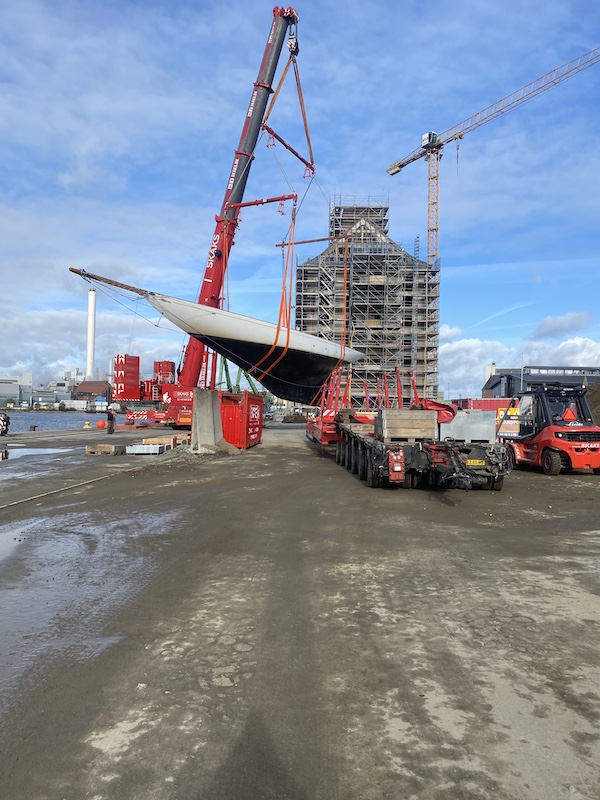
The cost of lifting Cambria out of the water and transporting her into the shed in Flensburg was significant. As there is no travel lift or slipway to haul Cambria, a heavy lift crane and transporter trolley was organised with a Danish company SKAKS. The logistics involved require communication between councils and Police departments for road closures, as a result, pending weather, plans made had to be kept, Cambria had to be ready. This was not an issue at the start of the project as she was there early, prepped and ready to go, but there would always be the pressure of being ready at the other end of the project when Cambria was to go back in!
Whilst we waited for the crane lift, (which had been scheduled for the 16th of October, 3 weeks after we arrived, putting us nearly one month behind schedule before even starting…..) we set to work emptying Cambria of all items; sails, lines, rigging, tools, spares, store/provisions, galley items (including oven), soft furnishings, tables, chairs, doors, pipe cots, carpet and deck heads. (All interior items were moved over and stored carefully at the back of the maritime centre. Robbe and Berking Maritime Heritage Centre is part of the same building, with a dust and noise proof door separating it from the ‘Cambria’ shed. The Heritage centre also houses one of the largest and best collection of Maritime books). All other items which need to be accessible were stored in two 6m containers which would be moved into the shed once Cambria was in position.
The mast was de-rigged leaving only man halyards necessary for rigging the lifting strops. Dave and Jean Michel (our long serving race crew member/delivery crew/Amazing rigger/ surrogate crew member), with plenty of help from Archie and Alice looked after this enormous job, meticulously labelling everything so iot could all go back together and be stored seamlessly. Whilst we were doing this the yard team was moving boats inside the shed to make space for Cambria and busy extending a portion of the shed to accommodate the mast. This involved building a small 5m extension on the western end.
The crew house became available as of the 1st of October, so everything required was moved in on the Sunday. The crew house had only recently been vacated, so to add to the work list an extensive clean was required, fortunately Christophe had arrived with the crew truck, so an extra hand was greatly appreciated! We employed a number of extra past/race crew members to help out over the duration; Christophe, Louis, Jean- Michel, and Margie all spent time helping the project move along. The crew house was 5 minutes by car, 10 minutes downhill by bike or 45-minute stroll, perfect in fine weather, character building in the depths of Flensburg winter.
Once everything was off Cambria, we could set about protecting everything left below. We used sheets Correx, as we had in the past. It is perfect for the job, it was used to cover every exposed surface, this greatly reduces the work required at the end of the refit repairing ding/dents and scratches in the varnish.
It was at this stage we said goodbye to our Engineer Max who had been with us for 3 seasons and was moving on to new adventures. We also welcomed our new engineer, Finn. Nothing like joining a vessel being pulled apart for an extensive refit…..!!!
SKAKS arrived on the dock adjacent to Cambria on the morning of the 11th of October. The weather looked good for the mast and boom to be lifted onto trolleys on the 12th and provisionally it looked good for Monday and lifting Cambria. Dave and Jean-Mich had done a great job and the mast slid out perfectly and safely laid onto the custom-made trolleys. With mast out it could now be stripped of all standing rigging and spreaders. The mast had to wait for Cambria to go into the shed first so once stripped of rigging we pushed it down the dock to make way for the heavy lift crane to pick up Cambria.
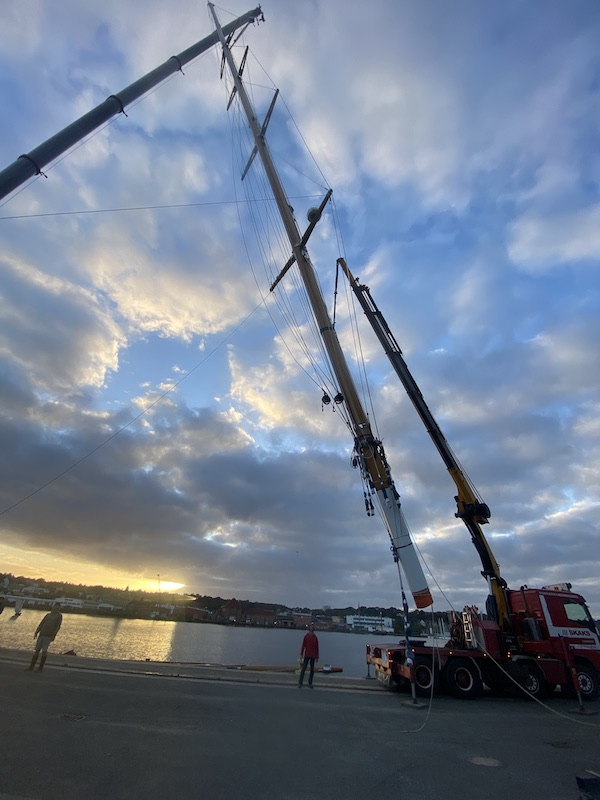
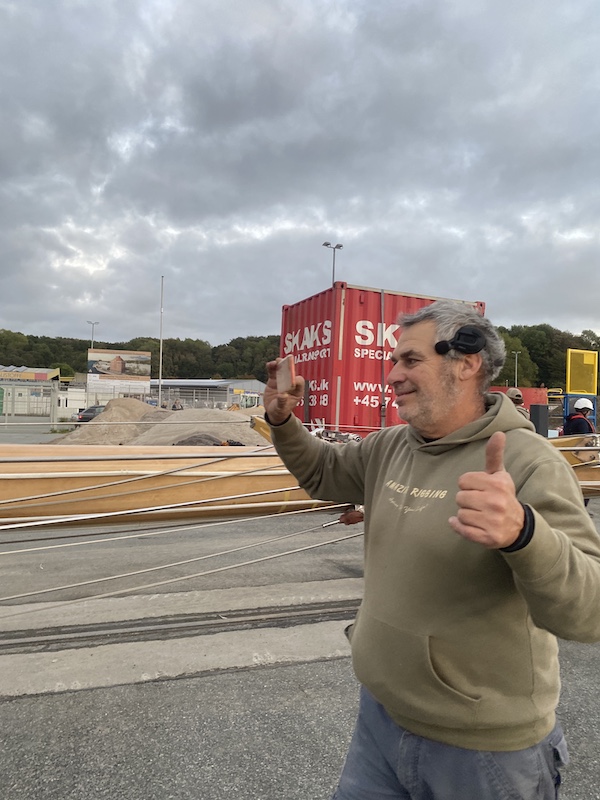
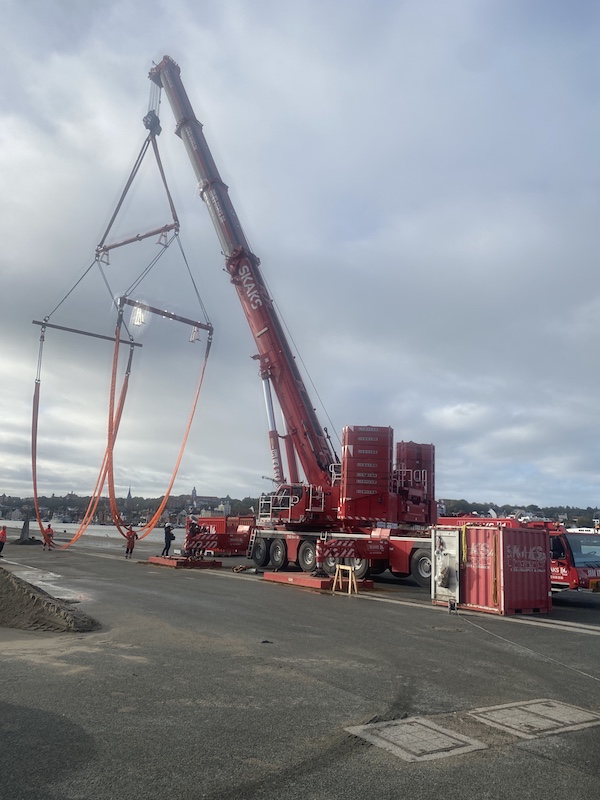
SKAKS arrived for the main lift at 0600 and started building the crane and trolly. Seven hours later Cambria was lifted clear, placed on the 96 wheeled hydraulically powered transport trolley. With her fully supported in a custom-made cradle she was driven 400m down a cobbled road, at stages with only 100mm clearance form signs and fences! The drivers of the trolley did a fantastic job keeping Cambria level as she traversed a very uneven surface. It fantastic that such a piece of machinery is controlled by level bubble. She arrived at the R&B shed, a moment of truce as she approached the shed door and passed clear of the entrance with a meter to spare! Once inside, Cambria and her cradle were lowered onto timber chocks and the trolly was removed. She was now in her place in the shed for the duration of the project. She would take a while to settle into her cradle, Jo and Ingo would plumb her and set reference points to keep an eye on her settling over the coming months. When removing the deck, particularly when repairing parts of the deck structure it is imperative to ensure the hull is supported in its correct position to ensure she maintains her shape.
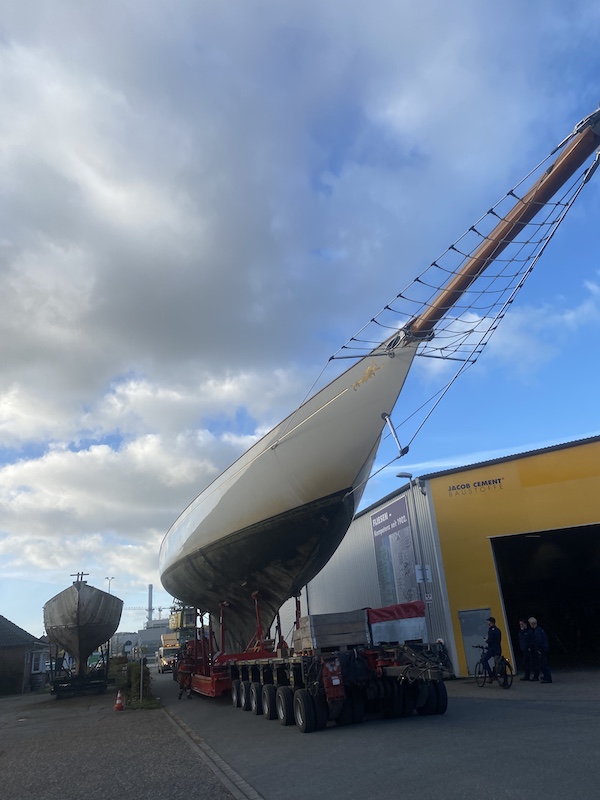
Scaffolding flew up on Thursday and Friday; a platform around the waterline for in preparation for the paint job at the end of the project, and the deck level platform providing a work area and access around the outside of the cap rail. Fencing and work benches incorporated along with power and air compressor outlets. Stair access at the bow and stern plus forklift access to the bow to transport heavy items on and off. This was first utilised to remove the 960 kgs of house batteries, 12 x 2-volt cells each 80 kgs each. The batteries were set up with Cambria’s charger at the back of the shed so they could be maintained over the duration. Shore power was connected and works on the deck commenced on the 19th of October, one month after we arrived.
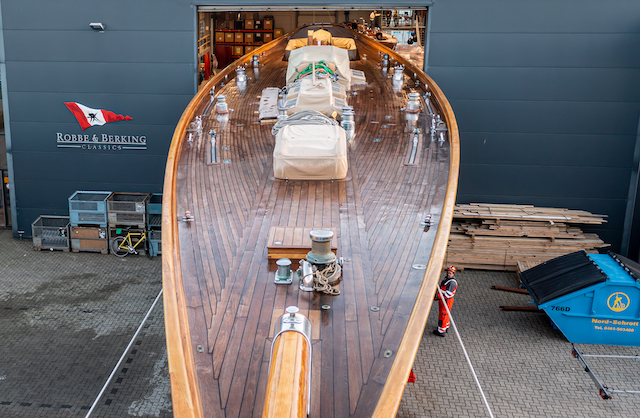
Cambria’s new winter home
With Cambria safely tucked up in the shed, the weather broke! Storm Babet crossed northern Europe on the night of the 20/21st of October. The rain and wind piled up the water in the Flensburg Fjord resulting in the highest tides since 1872 and causing major flooding and damage. The R&B crew spent most of the night tending to boats in their marina. We lashed Cambria’s mast to her trollies and then the trollies to the cranes on the dock. The water got to within 15cm of overrunning the dock. We pushed the mast into place inside the shed Monday morning the 23rd.
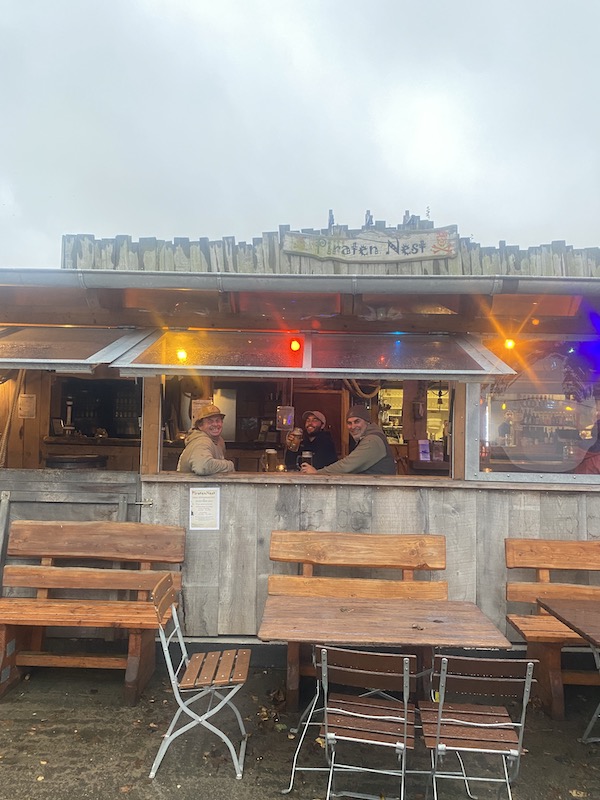
Crews new winter home….
Deck fittings (cleats, tracks, winches, eyebolts, pad eyes, and stanchion plates), deck furniture (hatches, fan locker), helm, helm seat, helm pedestal and covers made for all the openings now in the deck! All gear was removed, labelled, prepared for cleaning, polishing and stored ready for chroming. The crew built tents over the mast and boom plus a separate varnish tent.
With the crew accommodation clean and tidy, we said goodbye to Chef Tash (winter work commitments in the Alps) and deck stew Alice (sailing commitments in the southern hemisphere) and welcomed the extra refit crew; Sebastian (refit cook and labourer extraordinaire) and Sam Fletcher and Jack Jones from Lignum Boat Works. Sam worked with us back in 2014/15 on the refit at SYS. He now has his own business, LBW. Sam and Jack moved in with us providing the extra work level that would work on with the crew hours and on weekends when the R&B crew went home. Jack had previously worked with R&B on the Sparkman and Stevens Designed Baruna project.
Lead shipwright of the project was Johannes Hillerkuss. Jo had worked with R&B for many years and many projects. Jo is brilliant and there is no problem too difficult. Though Jo and R&B had completed many 12m yacht restorations, the Cambria project was the largest project through their shed doors. Though the process was the same, the job would be more difficult purely because of the scale. The extra manpower was certainly required.
Before cutting large sections of the deck out, we had to ensure the deck/hull joint was well braced so to ensure no movement. Six steel ‘I’ beam braces were spaced intermittently down the deck and were continually monitored until the full structural subdeck was reinstated.
Measurements were taken of the teak depth so circular saws could be used to cut out the planks and fibreglass to expose the sub deck. In many areas of the where water had found its way between these layers, the teak/fibreglass released easily from the pine. This was generally a sign the pine below was wet and potentially damaged. The glass still was glued to the teak, but no longer to the pine. Where we found the adhesion was sound, so to was the pine sub deck and steel work below.
By November’s end, the bow and stern steel work was exposed as was both port and starboard steel cover plates. The mast was also completely stripped, and the mast track re-bedded. The bulwark chock and veneer removed. The veneer was lost in the removal process, but large sections of the chock (Honduras mahogany) were saved and kept for later use where required. With the steel work exposed it was then cleaned up so it’s thickness could be measured. The basic rule of greater than 20% wastage would result in replacement. Cambria was then measured by ultrasound and the measurements marked on the steal. We engaged a local steel fabricating company to carry out the steel works and this would commence first week back in the new year. With the sub deck fully exposed we could order the yellow cedar for the pine deck repairs and the 13 mm marine Plywood was ordered. The final deck would consist of four layers: pine deck, ply deck, 3mm fibre glass and finally, on top, a 23mm teak deck.
December was filled with preparation for January. The bowsprit was released and lowered. The shed had a number of strategically placed sky hooks. There were several discolorations on the bowsprit particularly lower starboard side emanating from the heal fitting. This fitting had not been removed since it was epoxied on back in 1995. This would become a challenge for later in the refit. With the bowsprit removed the full steel apron of the bow was exposed and could be measured. The steel work by the way of the helm seat and next aft frame bay with the main winch was also exposed and prepared for renewal. It was also the first time the aftermost three bays were exposed since repairs to the area back in 1995; the last time the deck was replaced. This area cannot be accessed from below deck, as a result we did not carry out repairs in this area back in 2014/15. Opening the space is like opening a time capsule as no one had seen this space since the shipwrights at Norman Wright and Sons closed the deck in 1995. The red lead paint still apparent after 30 years. It also opened the deadwood at the transom for inspection. Now exposed we needed to let it dry out and plan its repair.
Areas of rotten pine deck were cut out and scarfs cut in preparation for graving pieces. Lengths of Alsakan yellow cedar, supplied by our long-term wood supplier, guru, classic yacht expert, Cambria race crew member and general great person; John Lammerts Van Buerren’s Touchwood BV, were laminated together to make cover boards to go on after the steel repairs were completed. Repairs to the bulwark was particularly time consuming. The top section of the sheer plate had corrosion and was cut out. Behind this plate the mahogany plank had suffered. As we discovered back in 2014/15 there 12” long bronze dumps dovetailed down through these top planks under the cap rail. As a result, many mahogany graving pieces were fitted around the now exposed dumps to fill the void to allow the new sheer plate. The construction of the bulwark consisted of cap rail, two planks fastened vertically with bronze dumps, horizontally with large gauge bronze wood screws through sheer plate above deck angle, then bolted through frames and sheer plate below deck angle.
Insert Drawing Steel section
Areas where the corrosion was crossing multiple frames, steel support rods were welded in to maintain shape and structural stability before sections of cover plate under the required thickness, were cut out. Steel work which was still in good condition was wire wheeled, ground and cleaned prepped and primed with multiple coats of an epoxy primer.
December also brought the snow and darkness of northern Germany winter. Good fun for snow fights but sometimes leading to tricky car parking……! We were hitting the first of the solstices, winter Solstice defined by the shortest day light hours of the year. The positive is that from now on the day light hours are getting longer and the summer sun is on its way……
After the Christmas and New year break the yard seemed refreshed and now focussed on the works. With now all areas uncovered and unrestricted access, the welders and fabricators moved on. Steel king plates were inserted from forepeak hatch to apron and main sheet winch to helm. Smaller sections of cover board plate, which had been fabricated off site in December were installed. Up forward, once the king plate and cover plates had been repaired the apron was cut out and a new plate welded in. All plate cut out was replaced with the same dimension as originally in installed, for example the coverboard plate and apron was ¼ inch and was replaced with 6mm Coreten steel.
With progress in the steel work, attention returned to the last four bays before the transom. The planking had now dried out and could be properly inspected. There were several areas which required attention and with such good access we took on the challenge to add a further job to the list, remembering our deadline of mid-June with launching. This gave the steel workers a finish line and, as a result, all the knock-on work could be planned accordingly. Repairs to 8 planks about the transom ranging from 1.3m to 3m in length. Rotten sections were cut out and then either scarfed back together, or where available a but plate was used. The works were again staggered to maintain shape and form in the transom and horn timber area. Sipo mahogany was used to match
The last of the steel work was completed by mid-March, new lands were welded on the final floors before the transom and the sheer plate by way of where it met the bilge plate and cover plate. As the transom planking was completed by a second team of ship wrights was moving down the deck completing the pine sub deck, including splining. The plan had always been to reinstate the correct camber on the deck. Over the years this had been worn down and in certain areas, by way of the mast and cockpit particularly, was nearly flat. Water would pool inside the scupper rather than drain out! With the pine deck complete, Alaskan yellow cedar veneers were glued on in the hollows and the deck was faired to its original camber. Once returned, the deck was ready for the next layer, the ply.
To reduce the likely hood of water ingress, we chose vacuum bagging to attach the ply. This method removes the need of mechanical fastening. Vacuuming bagging uses air pressure as a clamp and removes the possibility of voids where moisture can accumulate. Jo and his team had used this method many times on the 12m’s they worked on. For me, I’d never seen it at this scale. Full panels laid diagonally. By laying on 45 degrees to centreline further rigidity is added to the deck. Holes are drilled into the panels (sounds counter intuitive…..!!!) which allows the air to escape, the glue filling the holes. As ply works continued, the aft deck bilge was painted out and the pine deck completed, sealing the deck again on the 24th of April. Remembering the crane booked for the 20th of June this left us 8 weeks to complete the task. As in all projects, it’s the preparation which takes time. With the pine deck now complete, so to was the preparation for laying the teak. Two days later, the 26th, the ply was complete and ready to cut the prisms into and to prepare the plywood areas about the chainplates in readiness for the layers of glass. As we did in the 14/15 refit, once the sub surface was prepared for the glassing, peel ply was added to making the process more efficient by reducing the sanding component prior to laying glass (2 x 300 biaxial cloth). The glass was laid into the deck openings (prisms and chain plates). At the end of April we said goodbye to shipwright Jack Jones who’d been working with us since last November. We had originally planned to be finished by the end of April and as a result Jack had prior commitments to attend to. Jacks last project was to complete works to the bowsprit. Dave and Jo had managed to get the heal fitting off back in December and found rotten timber about the through bolts. (we had not known about the through bolts previously as the heads had been polished over and not visible) The heal fitting was modified slightly to allow future works to be more easily carried out! It was sad to see him leave before the end of the refit but great to have been able to work with him.
With the time pressure building we called Ashley Butler, a very good friend and member of the 2014/15 team, who was ready to send two extra boat builders to join us. They arrived for the final push at the start of May and by the 10th of May the glassing was finished, the fairing of the transom complete and a coat of undercoat, 545 was on. The veneers for the bulwark were templated, cut and glued on, the Honduras mahogany was a perfect match for the cap rail; the bulwark chock was the same. The teak deck battens were also joined in 35m lengths. This would further speed up the process of laying the deck, not only with the gluing and clean up, but also by allowing the edge bending to happen seamlessly with a fair curve following the layout of the old deck exactly. The king planks and coverboards were to be completed last.
Jo drew up the deck in situ on the peel ply. This allowed us to calculate the lengths and final calculations of stock. Which stock to use where. We had changed the layout of the deck by removing the deck furniture margins, returning her to original. With battens made and the drawing complete, the first of the teak deck was laid on the 21st of May. with the vacuum bagging method, five strakes could be laid at once.
The process was to shape, fit, clean, then glue and repeat! The aim being to always have as section glued by days end so. As a result, the deck battens rapidly covered the deck working from the margins to the centreline. In the background, Dave started sanding the topsides preparing to paint top sides. We had to do this outside of dust producing hours, tricky…… it took 5 crew rolling and tipping an hour and fifteen minutes to apply the first coat on Saturday the 7th and another hour on Sunday to apply the second coat: job done! Varnishing was next. Cap rails, the newly glued bulwark veneers and chocks needed to be sealed with 50/50 then built up with as many coats of Woodfinish we could. Extra crew arrived to help with the varnish; Christophe and the rigging preparations; Jean Michel and Louis. The new standing rigging, cap shrouds, d’s and v’s; arrived at the yard on the 13th of June. Fortunately, all measurements were within tolerance, and we were ready to fit when the mast went in on the 21st. The bowsprit, its own refit competed and fully varnished was stepped on the 15th of June and ready for dressing.
The process of laying the deck only took three weeks including caulking the seams. The team was fantastic. Yard and crew was relentless in achieving the goal often finishing well into the early hours of the following morning.
The deck was now complete; it was Sunday the 16th of June.
Scaffold was scheduled to be dismantled Tuesday and Wednesday with the Skakks crew arriving to build the transport trolley. With the scaffolding removed, the antifouling was rolled on. The weather was also behaving; the launch would go ahead on Thursday the 20th of June. We still had a mountain of work to complete before sailing; our ETD was set for July 8th. Shafts had long been reinstated with new cutlass bearings. The thrust bearings were in and connected. All interior painting had been completed. The new nav gear had arrived and the new antennae/scanner installed on the spreader trays. Dave and Finn milking on the new cover for the cables, ready to go.
Fittings had to be cut in, bedded and bolted. The prisms, winches, winch switches, cleats, tracks and anchor windlass. The stanchion base plates, mast eye bolts and pad eyes. We prioritised deck fittings to what was required for the lift and then mast stepping, the rest would wait until we were in the water.
End of shed time team dinner.
The Cambria Robbe and Berking deck team 2024.
The transfer of Cambria back into Flensburg Fjord and the stepping of the mast went smoothly and calmly. A new sterling silver Krugerrand from Robbe and Berking was placed under the mast as has been our tradition. The following two weeks were flat out finishing and bedding deck fittings, commissioning nav equipment, extra varnish layer and generally preparing for the 3000 Nm back to the Med and the first summer cruise around Mallorca.
The end of the project was a blur as weather windows became priority, and I feel we didn’t acknowledge the amazing work of all involved as we should have. I am forever in their debt. The commitment, skill and effort of the 23/24 Cambria deck refit team is not only immortalised in the latest Cambria merch but also in my heart and memory. Looking down the beautifully swept teak deck it will always be remembered.
Above all, the passion and commitment of the owner and his family to maintaining Cambria to the highest level is phenomenal. This project marks the end of the 4 main projects originally envisioned back in 2004. The mast; the systems; the hull and finally the deck. Cambria is looking better than ever both aesthetically and, importantly, structurally. She is ready for the next 30 plus years.